ARTHRITIS
INTRODUCTION
ARTHRITIS from Greek arthro-, joint + -itis, inflammation; plural: arthritides) is a group of conditions involving damage to the joints of the body.
There are over 100 different forms of arthritis.The most common form, osteoarthritis (degenerative joint disease) is a result of trauma to the joint, infection of the joint, or age. Other arthritis forms are rheumatoid arthritis, psoriatic arthritis, and autoimmune diseases in which the body attacks itself. Septic arthritis is caused by joint infection.
The major complaint by individuals who have arthritis is pain. Pain is often a constant and daily feature of the disease. The pain may be localized to the back, neck, hip, knee or feet. The pain from arthritis occurs due to inflammation that occurs around the joint, damage to the joint from disease, daily wear and tear of joint, muscles strains caused by forceful movements against stiff, painful joints and fatigue. The most important factor in treatment is to understand the disorder and find ways to overcome the obstacles which prevent physical exercise. Rheumatoid arthritis is generally worse in the morning and associated with stiffness; in the early stages, patients often have no symptoms after a morning shower. In the aged and children, pain might not be the main presenting feature; the aged patient simply moves less, the infantile patient refuses to use the affected limb.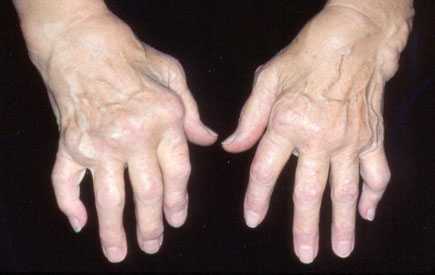
Arthritis is a disease of elderly, but children can also be affected by the disease. More than 70% of individuals in North America affected by arthritis are over the age of 65. Arthritis is more common in women than men at all ages and affects all races, etenic groups and cultures. An estimated 46 million individuals in USA have arthritis and the numbers continue to increase each year. Close to one million individuals are admitted to hospitals each year because of their arthritis. Elements of the history of the disorder guide diagnosis. Important features are speed and time of onset, pattern of joint involvement, symmetry of symptoms, early morning stiffness, tenderness, gelling or locking with inactivity, aggravating and relieving factors, and other systemic symptoms
While evidence of primary ankle (kaki) osteoarthritis has been discovered in dinosaurs, the first known traces of human arthritis date back as far as 4500 BC. In early reports, arthritis was frequently referred to as the most common ailment of prehistoric peoples.[3] It was noted in skeletal remains of Native Americans found in Tennessee and parts of what is now Olathe, Kansas. Evidence of arthritis has been found throughout history, from ?tzi, a mummy (circa 3000 BC) found along the border of modern Italy and Austria, to the Egyptian mummies circa 2590
In 1715 William Musgrave published the second edition of his most important medical work De arthritide symptomatica which concerned arthritis and its effects
